
EHRServer Implementation and Management Workshop
EHRServer is the first open source electronic clinical repository based on openEHR
Introductory - Intermediate | 6h | Live Online | 150 USD



 12 students have taken this course
Includes
3 sessions
Presentations
Reference materials
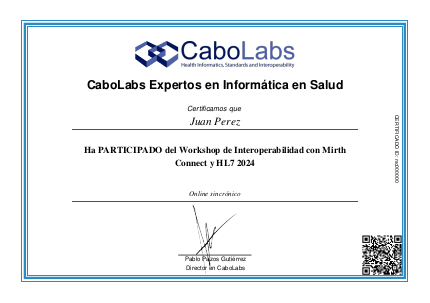
Certificate of participation
Skills covered by this workshop
openEHR Clinical Data Repositories
Course description
openEHR is a set of specifications for the components of clinical information platforms, including multiple desirable characteristics: vendor neutrality, technology independence, maintainability, standardized and versioned data, semantically coherent. In this workshop you will learn to work with EHRServer, the first open source clinical repository based on openEHR, to manage the server, electronic health records, documents, templates, and data queries.
Certificate
The certificate includes a QR code for sharing.
Instructor

Pablo Pazos
Integration EngineerProgram
Objective
The central objective of the workshop is to understand how EHRServer works, its purpose, capabilities, how it is configured and managed, and how it integrates with various clinical applications in different contexts, from a central repository for clinical recording systems to a backend for mobile applications.
Why is it needed?
The vast majority of existing clinical information repositories are closed, following custom models that are not based on standards and hinder interoperability. On the other hand, these repositories are complex, and creating them requires a large investment and expertise in the area, elements that are beyond the reach of many small and medium-sized software companies.
EHRServer emerges as an open solution for standardized clinical data repositories, complying with the international openEHR standard. With a generic and vendor-independent approach, EHRServer allows storing and retrieving any data structure without the need to modify source code or recompile the system, making it especially attractive for companies and organizations that want to create their own applications without having to create custom and non-standardized clinical repositories.
openEHR data can be mapped to other standards such as HL7 v2.x, CDA, FHIR and DICOM, which enables interoperability with various international clinical data exchange standards. It also supports any type of clinical terminology, such as SNOMED CT, LOINC, ICD-10, etc. SNOMED CT in particular is used to create semantic data queries, adding great power when obtaining data to support clinical decision-making.
Who is it for?
The main audience for this workshop is IT professionals and students (software architects, programmers, technical leads, network administrators, among others) with an interest in health information systems. Programming knowledge, XML, JSON and HTTP are recommended.
Certification
PARTICIPATION certificates will be issued to all students enrolled in the workshop.
Topics
- Introduction, history and purpose
- Main features
- Code and documentation
- Project management and issue reporting
- Installation and configuration
- Internal organization of accounts, users and permissions
- Internal organization of health records and documents
- Introduction to the openEHR information model
- Working with openEHR archetypes and templates
- REST API
- User management modes and authentication
- Creating and managing clinical data queries
- Integrating EHRServer in clinical recording applications
Related courses
Do you have any questions?
Let us know how we can help you.