
Clinical Database Design and Implementation with openEHR
openEHR is the open standard for future-proof electronic health records
Introductory | 25h | Live Online | 240 USD



 43 students have taken this course
Includes
4 sessions
Presentations
4 optional assignments
Certificate of participation/completion
Skills covered by this course
openEHR Clinical Data Repositories
Course description
The openEHR standard offers several advantages when defining, managing and evolving clinical information over time. An important aspect in the implementation of Health Information Systems is having good clinical information repositories that enable both patient care and secondary uses (education, research, epidemiology, etc.). In this course we will apply the principles of the openEHR specifications to design and implement standardized, high-quality clinical databases.
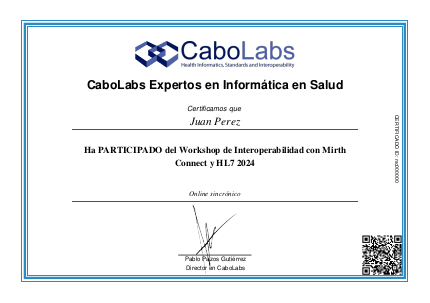
Certificate
The certificate includes a QR code for sharing.

Instructor

Pablo Pazos
Integration EngineerProgram
Objective
The central objective of this course is to shorten the gap between the openEHR specifications and their implementation, specifically in the area of clinical data storage and retrieval, using concrete database technologies. Upon completing the course, the student will have performed implementation tasks and will have a thorough understanding of the main challenges, best practices and solutions to some common problems when implementing the openEHR standard.
Why is it needed?
Clinical databases are complex to design and difficult to implement. The challenge increases when these databases must contemplate standards, be generic, consistent and of high quality. These elements will enable the interoperability of systems and the information they manage.
The openEHR standard offers specifications for good clinical documentation models, well organized and extremely flexible, but does not offer any recommendations for implementing the standard at the database level. This is the main reason we designed this course, to fill that gap.
We have more than 20 years of experience working with openEHR, and we designed the first open clinical data repository based on openEHR. We have channeled all our experience into this course, unique in the world.
Who is it for?
The course is aimed at IT professionals and students: software architects, programmers, database administrators, technical leads, among others. Clinical professionals with some background in programming languages and databases can also take the course without problems.
Knowledge of a programming language is recommended (Java/Groovy will be used as reference languages), relational databases and SQL.
Certification
PARTICIPATION certificates will be issued to all students enrolled in the course.
COMPLETION certificates will be issued to those who complete practical tasks and have an evaluation score above 6/10.
Modules
Introduction
- Clinical data, requirements and uses
- Clinical record structure
- openEHR information model: data and metadata
Design and Implementation
- Database implementation technologies
- openEHR implementation techniques at the database level
Archetypes and Templates
- Using openEHR archetypes and templates in software
- Data validation
Advanced concepts
- Indexing, versioning, auditing, synchronization, ETL
Related courses
Do you have any questions?
Let us know how we can help you.